How I Built a 4-Person AI Executive Team in 3 Weeks (COO, CMO, CFO, CEO)
Not one AI agent. Not a chatbot. A full C-suite (CEO, COO, CMO, CFO) each with clear responsibilities, each operating independently, each checking in daily with their work.
Most people treat AI like an assistant.
"Draft this email." "Summarize this document." "Answer this question."
That's an intern, not an assistant.
Here's what I did instead: I built an AI executive team.
Not one AI agent. Not a chatbot. A full C-suite (CEO, COO, CMO, CFO) each with clear responsibilities, each operating independently, each checking in daily with their work.
The platform: @OpenClaw (open-source).
I now wake up to a morning briefing, a triaged task list, drafted content, and completed operational work. Every single day.
This article breaks down the full framework.
PS: Ready to stop using AI and start building it?
Join the Build With AI community waitlist and be first in line when we open the doors → https://return-my-time.kit.com/1bd2720397
-----------------------------------------------------
Why "AI Assistant" Is the Wrong Mental Model
When you call it an "assistant," you position it below you.
You give it tasks. You check its work. You fix its mistakes.
That's fine for simple stuff. But it doesn't scale.
Here's the reframe: Treat AI like executives, not assistants.
Executives own outcomes. Assistants complete tasks.
Executives make decisions. Assistants wait for instructions.
The difference is autonomy.
When I treat my AI agent (Claire) like a COO, I give her entire workflows. She triages my tasks, drafts all the content, logs follow-ups, and presents me with ready-to-execute plans.
I don't micromanage. I review, approve, execute.
That's the leverage.
The AI C-Suite Framework
Here's how I think about my AI executive team:
1. The AI Chief Operating Officer (COO)
Role: Runs daily operations. Triages tasks, manages workflows, coordinates execution.
Real responsibilities in my business:
- Pulls today's tasks from Todoist every morning
- Classifies each task: Can Complete, Can Partially Help, Need Info, Requires Me
- Drafts all actionable content (emails, posts, follow-ups)
- Logs completed work in systems (CRM, task manager, calendar)
- Coordinates with my human assistant (Ingrid) on who does what
Why this works: I don't open Todoist and wonder "what should I do first?" I open Discord and see a complete triage report with priorities and drafts.
How it's built: OpenClaw + Todoist API + brand voice profiles + task classification logic
Morning output example:
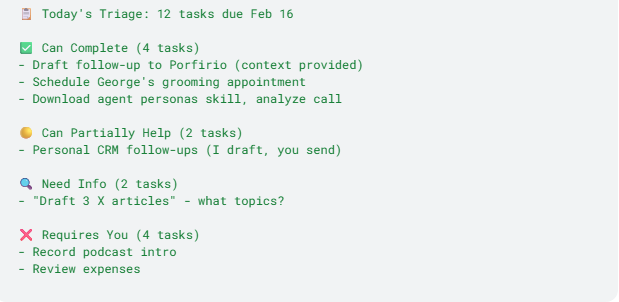
The shift: I stopped treating "task management" as something I do. It's something the COO does. I just execute.
2. The AI Chief Marketing Officer (CMO)
Role: Owns content strategy, production, and distribution.
Real responsibilities in my business:
- Researches trending topics in AI/automation space
- Drafts X articles (research → write → thumbnails → upload to Google Drive)
- Generates LinkedIn posts based on recent builds and learnings
- Creates social media graphics and thumbnails
- Repurposes long-form content into short-form posts
- Monitors engagement and suggests next topics
Why this works: I don't stare at a blank page wondering "what should I write about?" The CMO presents 3 draft options with reasoning.
How it's built: OpenClaw + X-article-writer skill + LinkedIn post templates + thumbnail generation (HTML + headless Chrome)
Weekly output example:
- 3-5 X articles (full drafts + thumbnails)
- 5-7 LinkedIn posts (with image options)
- 10+ YouTube topics (from article breakdowns)
- Content calendar with next week's topics
The shift: Content creation stopped being a "me" activity. It's a CMO activity. I review, edit, approve.
3. The AI Chief Financial Officer (CFO)
Role: Tracks spending, monitors revenue, flags financial decisions.
Real responsibilities in my business:
- Reviews daily business expenses (alerts on unusual charges)
- Tracks recurring subscriptions (flags unused tools)
- Monitors affiliate revenue and hosting signups
- Generates monthly financial summaries
- Drafts invoices for client work (Stripe integration)
- Flags tax-related items (quarterly reminders)
Why this works: I'm not constantly wondering "am I over budget?" or "did that charge go through?" The CFO monitors and alerts.
How it's built: OpenClaw + bank/credit card integrations + Stripe API + spreadsheet logging
Monthly output example:
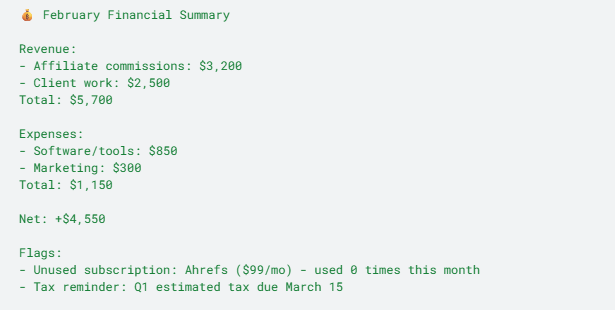
The shift: Financial oversight isn't something I "remember to do." It's delegated.
4. The AI Chief Executive Officer (CEO)
Role: Strategic planning, priority setting, big-picture thinking.
Real responsibilities in my business:
- Reviews weekly progress against goals
- Suggests strategic pivots based on data (what's working, what's not)
- Identifies bottlenecks in workflows
- Proposes new automation opportunities
- Synthesizes learnings into strategic memos
Why this works: I get a weekly "board meeting" with my AI CEO where we review what's working and what needs to change.
How it's built: OpenClaw + session logs + analytics data + goal tracking
Weekly output example:
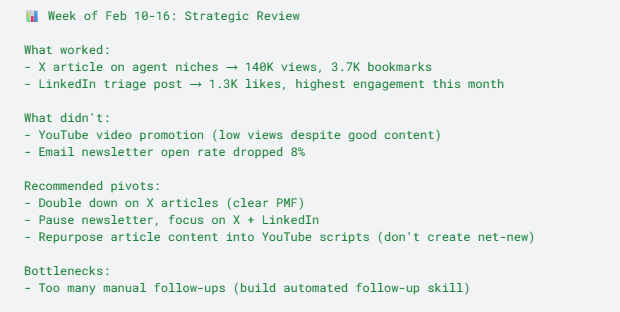
The shift: Strategy isn't something I do alone on a Sunday night. It's a collaborative review with data-backed recommendations.
How to Build Your AI C-Suite
You don't need all 4 roles at once. Start with one.
Here's the build order I recommend:
Phase 1: Hire Your COO (Weeks 1-2)
Why COO first: Operations is the biggest time sink. Triage, task management, follow-ups. This is where most founders waste 2-3 hours per day.
What to build:
- Connect Todoist (or your task manager) to OpenClaw
- Build task classification logic (Can Complete / Can Partially Help / Need Info / Requires You)
- Draft content for actionable tasks
- Present morning triage report
Tools: OpenClaw + Todoist API + task classification script
Time to build: 3-5 days (first version)
ROI: 1-2 hours saved per day immediately
Phase 2: Hire Your CMO (Weeks 3-4)
Why CMO second: Once operations are handled, content becomes the next bottleneck. You need consistent output to grow.
What to build:
- Research trending topics in your niche
- Draft articles/posts using your brand voice
- Generate thumbnails and images
- Upload to Google Drive or staging area
- Present weekly content calendar
Tools: OpenClaw + X-article-writer skill + brand voice profile + headless Chrome for images
Time to build: 5-7 days (first version)
ROI: 3-5 hours saved per week on content
Phase 3: Hire Your CFO (Weeks 5-6)
Why CFO third: Once you're operating efficiently and creating content, financial oversight becomes critical. You don't want to discover a $500/mo unused subscription 6 months later.
What to build:
- Connect bank/credit card accounts (or manual expense logging)
- Track recurring subscriptions
- Monitor revenue sources
- Generate monthly summaries
- Flag unusual spending or unused tools
Tools: OpenClaw + Plaid API (for bank access) or manual Google Sheets logging
Time to build: 5-7 days
ROI: Catch 1-2 unused subscriptions = pay for itself
Phase 4: Hire Your CEO (Weeks 7-8)
Why CEO last: Strategy only matters when you have data. You need to run COO + CMO + CFO for a month to generate enough signal for the CEO to analyze.
What to build:
- Pull data from COO (task completion rates), CMO (engagement metrics), CFO (revenue/expenses)
- Identify patterns (what's working, what's not)
- Generate weekly strategic review
- Suggest pivots and priority changes
Tools: OpenClaw + data aggregation scripts + strategic prompt templates
Time to build: 5-7 days
ROI: 1-2 strategic insights per month that compound over time
The Tech Stack (What You'll Actually Need)
Core platform: OpenClaw (open-source, self-hosted)
Integrations you'll connect:
- Todoist (or any task manager with API)
- Gmail / email provider
- Google Drive (for file storage)
- Stripe (for invoicing)
- Bank/credit card (via Plaid or manual logging)
- Discord or Slack (for daily check-ins)
Skills you'll build:
- Task triage skill
- Content generation skill
- Follow-up automation skill
- Financial monitoring skill
- Strategic review skill
Cost breakdown:
- OpenClaw: Free (self-hosted)
- Claude API: $20-50/month (depending on usage)
- Integrations (Todoist, Gmail, etc.): $0-30/month
- Total: $20-80/month
Compare that to hiring 4 executives at $200K+ each.
The Daily Workflow
Here's what my morning looks like now:
7:00 AM: Open Discord. Claire (my AI COO) has already:
- Pulled today's 12 tasks
- Classified them into 4 categories
- Drafted 4 emails, 2 LinkedIn posts, 1 follow-up
- Flagged 2 tasks that need my input
- Coordinated with Ingrid (human assistant) on who's handling what
7:10 AM: I review the triage, approve drafts, answer the 2 questions
7:15 AM: Ingrid executes (sends emails, books appointments, handles logistics)
7:30 AM: I execute my "Requires You" tasks (recordings, calls, decisions)
8:00 AM: Deep work. Operations are handled.
Before this system, I'd spend 7:00-9:30 AM triaging tasks, drafting emails, figuring out priorities.
Now it takes 30 minutes.
That's 2 hours back. Every day.
The Real ROI
The real ROI from this setup is leverage.
Before AI C-suite:
- 12 tasks felt like 12 tasks
- Content creation took 4-6 hours per week
- Financial oversight happened "when I remembered"
- Strategy happened on Sunday nights (maybe)
After AI C-suite:
- 12 tasks → 4 tasks (8 handled by AI)
- Content creation is automated (I review/edit)
- Financial oversight is continuous
- Strategy happens weekly with data
The real unlock: I don't context-switch into operations mode anymore.
I review, approve, execute. That's it.
The COO handles operations. The CMO handles content. The CFO handles money. The CEO handles strategy.
I handle relationships, vision, and decisions.
That's how a $200K/year solopreneur starts operating like a $2M/year company.
Key Takeaways
- Stop treating AI like an assistant. Treat it like an executive team.
- Four roles: COO (operations), CMO (marketing), CFO (finance), CEO (strategy).
- Build in order: COO first (biggest ROI), then CMO, CFO, CEO.
- Tech stack: OpenClaw + Claude API + integrations = $20-80/month.
- Real ROI: 2-3 hours saved per day + strategic leverage.
- The shift: You review and approve. AI executes.
If you want to build this, start with the COO. Get task triage working. Everything else builds from there.
PS: Ready to stop using AI and start building it?
Join the Build With AI community waitlist and be first in line when we open the doors → https://return-my-time.kit.com/1bd2720397