how I built an AI-powered content machine in 2 hours (6 steps)
But if you don't have a repeatable system that sounds like YOU then you just end up putting out generic garbage and ruining your reputation.
I use AI to create my content.
Not some of it. All of it.
Your favorite creators are doing it too.
NOT using AI for writing in 2026 is absolutely insane.
But if you don't have a repeatable system that sounds like YOU then you just end up putting out generic garbage and ruining your reputation.
So I'm going to show you the 6 steps I followed to build my automated content machine that writes in my voice using data-backed hooks, formats, and structures.
Enjoy.
(PS: borrowed this framework from @boringmarketer. Follow him, you won't regret it)
(PPS: I built this system for LinkedIn but you can apply the EXACT SAME process to any platform, X included)
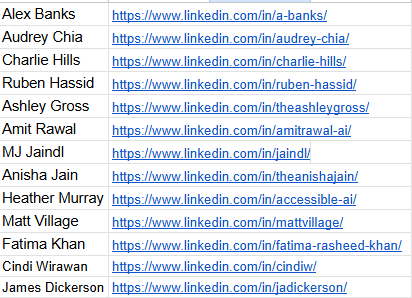
Step 1) I compiled a Google sheet of the top 13 creators in my niche
You want at least 10 creators on this list, up to 20. I chose 13 because they're 13 people I engage with regularly.
Here's my list:
Step 2) I signed up for Apify and got the LinkedIn Post Search Scraper for $0.10 per page
I had a million people ask me the exact actor I used so here is a screenshot of it.
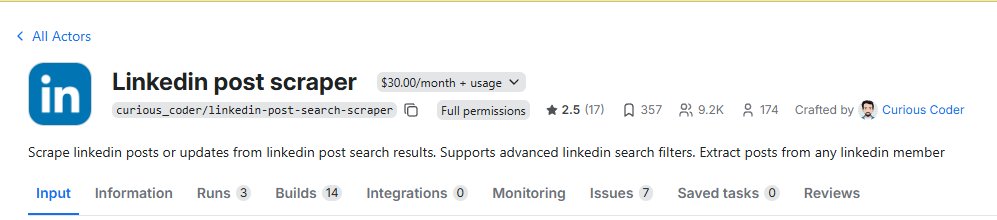
This actor offers a free 3 day trial so I was able to scrape all the data completely free.
Step 3) I set up cookies, user agent, source URLs, and rate limits in Apify
This step might sound intimidating (it was to me at first) but you need to remember we live in a world with AI.
I literally took a screenshot of the actor in Apify, pasted it into Claude, and asked it to walk me through setup step by step as if I was a non-technical person.
Here are screenshot of the full setup if you don't feel like asking Claude yourself:
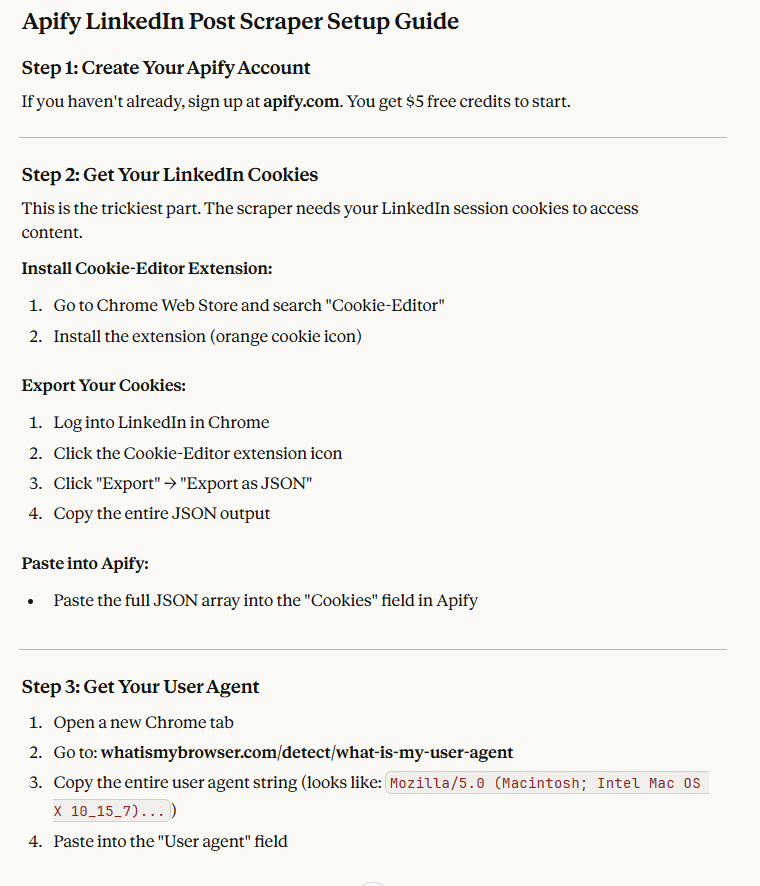
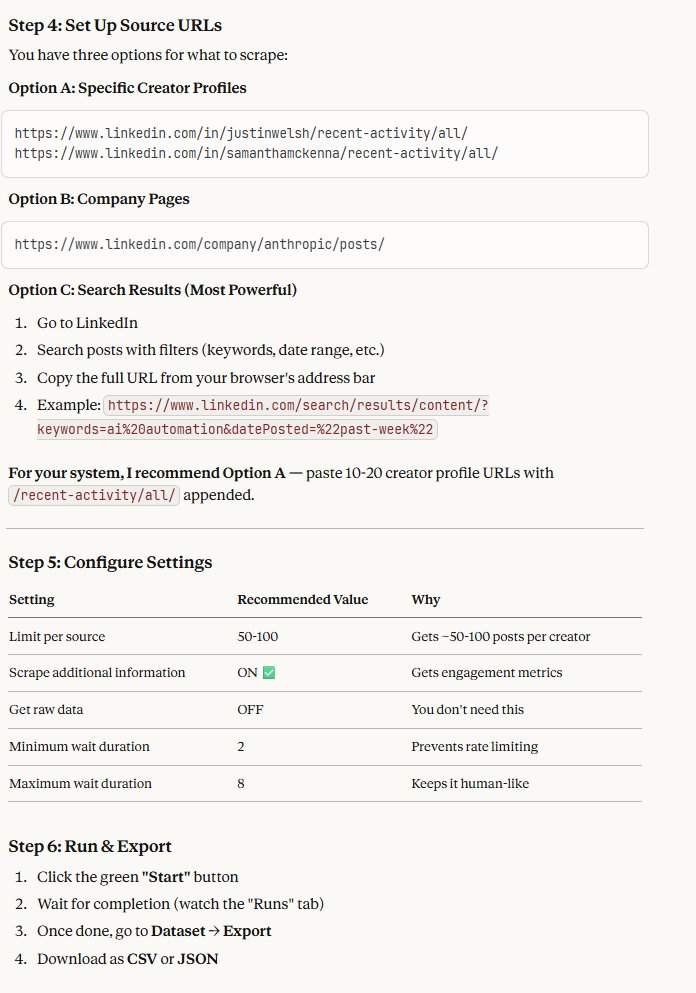
The "limit per source" setting is what determines how many posts you scrape per creator. I recommend 50-100 per creator.
Step 4) I asked Claude to analyze the scraped data
Apify will output the scraped data in JSON format (it's too much data to export as a single CSV), so I pasted the JSON into Claude and asked Claude to turn it into a CSV.
Then I dumped the CSV into Claude and told it to look for the following:
Quantitative patterns:
- Engagement thresholds (what qualifies as "high-performing" in your dataset)
- Correlation between post length and engagement
- Media type impact (text-only vs. image vs. carousel vs. video)
- Posting time/day patterns if timestamps are included
Qualitative patterns (the gold):
- Hook structures that drive highest engagement
- Opening line formulas (question, stat, bold claim, story)
- Formatting patterns (line breaks, spacing, emoji usage)
- CTA types and placement
- Topic categories that resonate
Deliverable: A pattern playbook document with specific, copy-able templates extracted from the top performers.
Here are some examples of trends that Claude found within the data:
• Images crush video. 70.5% of top performers were images. Only 8% were video.
• Arrows matter. Top posts use → and ↳ at 2.5x the rate of low performers.
• CTAs aren't optional. 85% of top 10% posts end with a CTA.
• Longer wins. 1,559 characters average for top posts vs 1,268 for bottom.
• Two creators to study: Charlie Hills (38% hit rate) and Ruben Hassid (36% hit rate).
Step 5) I asked Claude to extract the exact patterns of successful posts and hooks
Based on Claude's analysis of the scraped data, it gave me:
• 7 hook formulas
• 6 post templates
• 30+ proven examples
Step 6) I turned the formulas/templates/examples into Claude Skills
If you're unfamiliar with Claude's skills, think of them as SOPs for very specific tasks in your business. You could have a skill for drafting emails, a skill for writing marketing copy, a skill for landing page design, etc.
These are the 2 skills I built using the scraped data:
- linkedin-hook-writer: generates opening lines using 7 proven formulas
2. linkedin-post-writer: creates full posts from 6 tested templates
(I had already created a skill for my Brand Voice so that it writes hooks and posts in MY voice instead of just copying the top creators)
In addition to the 2 skills I created (which are assets that I will use repeatedly over time), I also generated these 3 reference file assets:
- hook-swipe-file: md file of 30+ top performing hooks + fill-in-the-blank templates
- post-templates: md file with structures for story, contrarian, case study, list, curation, giveaway posts
- pattern-playbook: md file with the data - what works, what doesn't, benchmarks
The final result:
Any time I want to write a LinkedIn post, I ask Claude to use my LinkedIn hook writer skill to write the hook, LinkedIn post writer skill to draft the body, and my Brand Voice skill to make it all sound like me.
I go from idea -> finished post in seconds.
The full system (summary):
Scrape creators (Apify)
↓
Analyze patterns (Claude)
↓
Generated hooks (linkedin-hook-writer skill)
↓
Write full posts (linkedin-post-writer skill)
↓
Apply my voice (brand-voice-skill)
↓
Ship content
Now I need you to do 2 things:
- Follow me if you got value out of this article. I will be posting more in-depth guides on AI agents, automated systems, and AI best practices
- Get a free custom AI Action Plan that gives you actionable steps for implementing AI into your business at www.returnmytime.com/quiz